Tankless water heaters are marketed with a tempting promise: hot water when you want it, a compact appliance and no giant storage tank sitting in the garage or closet.
For the right Los Angeles home, a tankless system can be an excellent upgrade. For the wrong home — or a poorly planned conversion — it can become an expensive project that solves a problem you did not actually have.
The question is not “Are tankless water heaters good?” The better question is: Is tankless a good fit for this house, this family and this installation?
What tankless actually changes
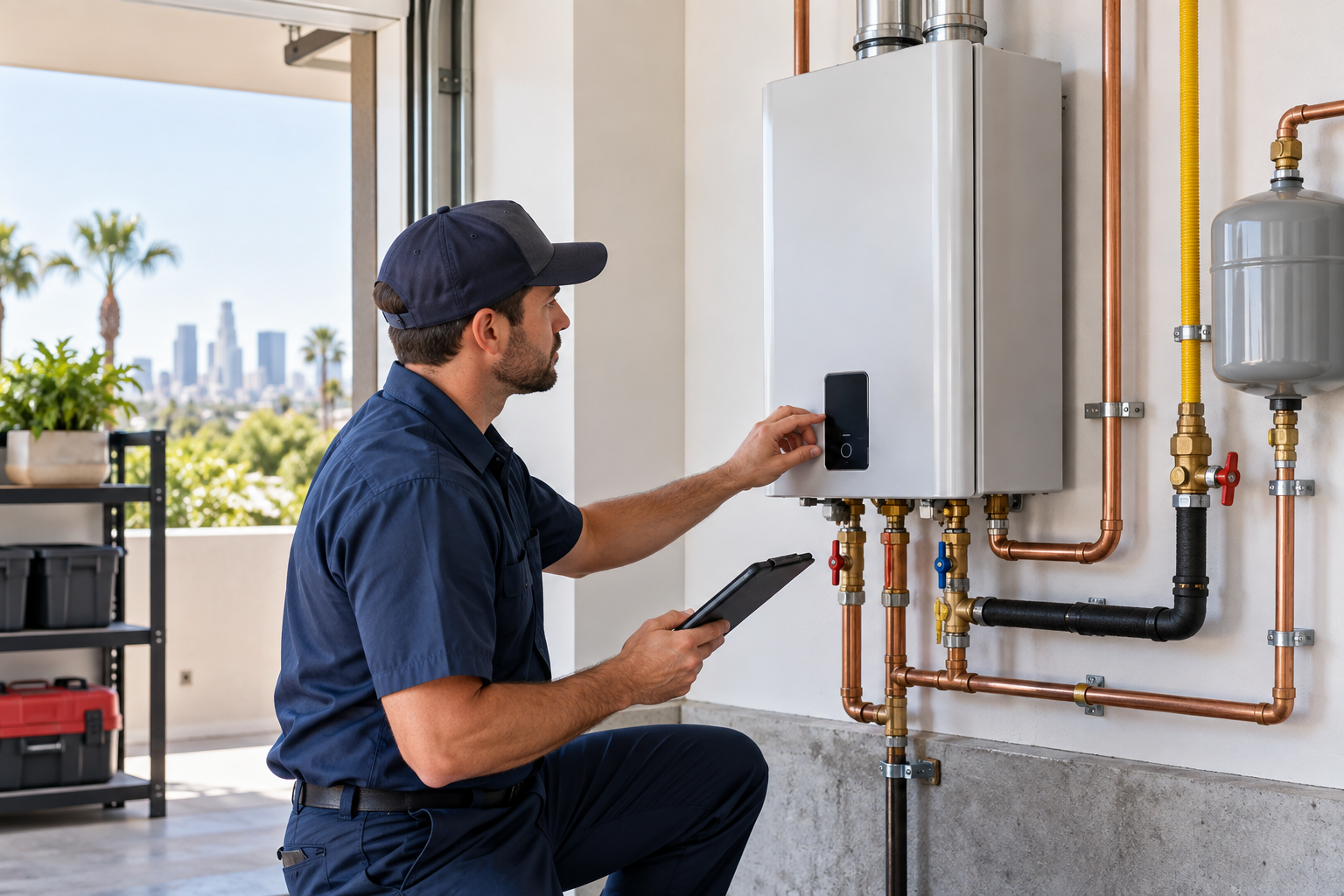
A traditional tank heater stores hot water and reheats it as needed. A tankless heater warms water as it flows through the unit.
That means you are no longer limited to a fixed tank volume in the same way. But tankless systems still have limits. Every model has a maximum flow rate and temperature-rise capability.
If several showers, faucets and appliances call for hot water at once, the system must be sized for that simultaneous demand.
“Endless” hot water does not mean unlimited hot water at unlimited flow.
The hidden cost is often the conversion, not the heater
Homeowners sometimes compare the retail price of a tankless unit with the price of a tank and assume the difference represents the whole project.
It may not.
A conversion can require changes to gas supply, venting, electrical service, condensate drainage, water connections and the mounting location. The exact requirements depend on the equipment and existing home.
That is why a serious estimate should separate the appliance from the installation infrastructure.
Ask: “What needs to change in my house to support this system properly?”
Who tends to love tankless systems
Tankless can be especially attractive when:
- The household regularly runs out of stored hot water.
- Space is valuable and eliminating a tank creates useful room.
- The owner plans to stay long enough to value the upgrade.
- The home’s gas, electrical and venting conditions make conversion reasonable.
- The system is correctly sized for simultaneous demand.
- The homeowner is willing to follow recommended maintenance.
In those situations, tankless can feel like a genuine lifestyle improvement rather than a gadget.
Who may be better off with a traditional tank
A standard tank can be the smarter financial choice when:
- The existing tank location already works well.
- Hot-water demand is predictable and adequately served.
- The owner wants the lowest-complexity replacement.
- Conversion requires major infrastructure changes.
- The property may be sold before the homeowner receives much value from the upgrade.
- Simplicity and lower upfront cost are the priorities.
There is nothing outdated about choosing the system that fits the property best.
The sizing mistake that ruins the experience
Tankless performance depends heavily on flow.
A system may have no problem serving one shower, but the experience changes if two showers, a dishwasher and a washing machine all demand hot water simultaneously.
Proper sizing considers how many fixtures may operate together, desired outlet temperature and the incoming water temperature the heater must raise.
Do not choose tankless based only on the number of bathrooms or a marketing label. Ask the installer how the proposed model was sized.
Maintenance still matters
Tankless does not mean maintenance-free.
Mineral accumulation and operating conditions can affect heat exchangers and performance. Manufacturers provide maintenance requirements that may include periodic flushing or descaling depending on water conditions and equipment design.
Homeowners should budget for proper service rather than assuming the unit can be ignored for years.
A well-maintained system is more likely to deliver the performance you paid for.
What about energy savings?
Tankless systems avoid storing a large volume of hot water continuously, which can reduce standby energy losses. Actual savings depend on household usage, equipment efficiency, fuel costs and how the new system compares with the old one.
Be cautious with anyone who promises a specific payback period without knowing your current system, usage and conversion cost.
For many homeowners, the decision is not purely about utility savings. Space, comfort, hot-water availability and long-term plans matter too.
Tankless is not a cure for every hot-water problem
If one shower fluctuates between hot and cold but every other fixture works, the problem may be at the shower valve rather than the heater.
If hot water takes a long time to reach a distant bathroom, switching to tankless at the same location may not automatically eliminate that wait. Distribution distance and recirculation design may matter.
If water pressure is poor, installing a new heater does not necessarily fix the supply-pressure problem.
Diagnose the complaint before selecting the product.
Seven questions to ask before converting
- What flow rate does my household actually need?
- What model and capacity are you proposing, and why?
- Does the gas line need to be upgraded?
- What venting or condensate work is required?
- Does the electrical setup need modification?
- What maintenance does the manufacturer require?
- What is the total installed price, including all conversion work?
If an estimate cannot answer those questions, it is not complete enough to compare.
A better way to think about “worth it”
Tankless is worth it when the benefits you care about justify the installed cost and complexity.
For one family, never running out of hot water during back-to-back showers may be worth a premium. For another, a reliable tank heater at a much lower installed cost is the obvious winner.
There is no universally correct answer.
If you are replacing a water heater in Los Angeles, ask for two scopes when practical: a properly sized conventional replacement and a properly engineered tankless conversion. Compare the total installed cost, expected maintenance, household comfort and how long you plan to own the property.
That comparison turns “tankless sounds cool” into a decision you can actually defend.
Talk with Extreme Plumbing & Rooter
Extreme Plumbing & Rooter is a licensed Los Angeles plumbing company (CA #1086230) serving homes and businesses 24/7. If you want a clear diagnosis and a free, no-pressure estimate, call (818) 631-7296 or send a short message.